






Claude Code is the implementer, not the evidence source.
Repository code can look correct while production serves an old build, blocks crawlers, renders an empty shell, or publishes conflicting URL signals.
Inspect the production site first, then hand Claude Code one evidenced issue with file boundaries, safety rules, and a definition of done.



Move from generic SEO prompting to a scan-backed implementation queue.
Open the SEO Workspace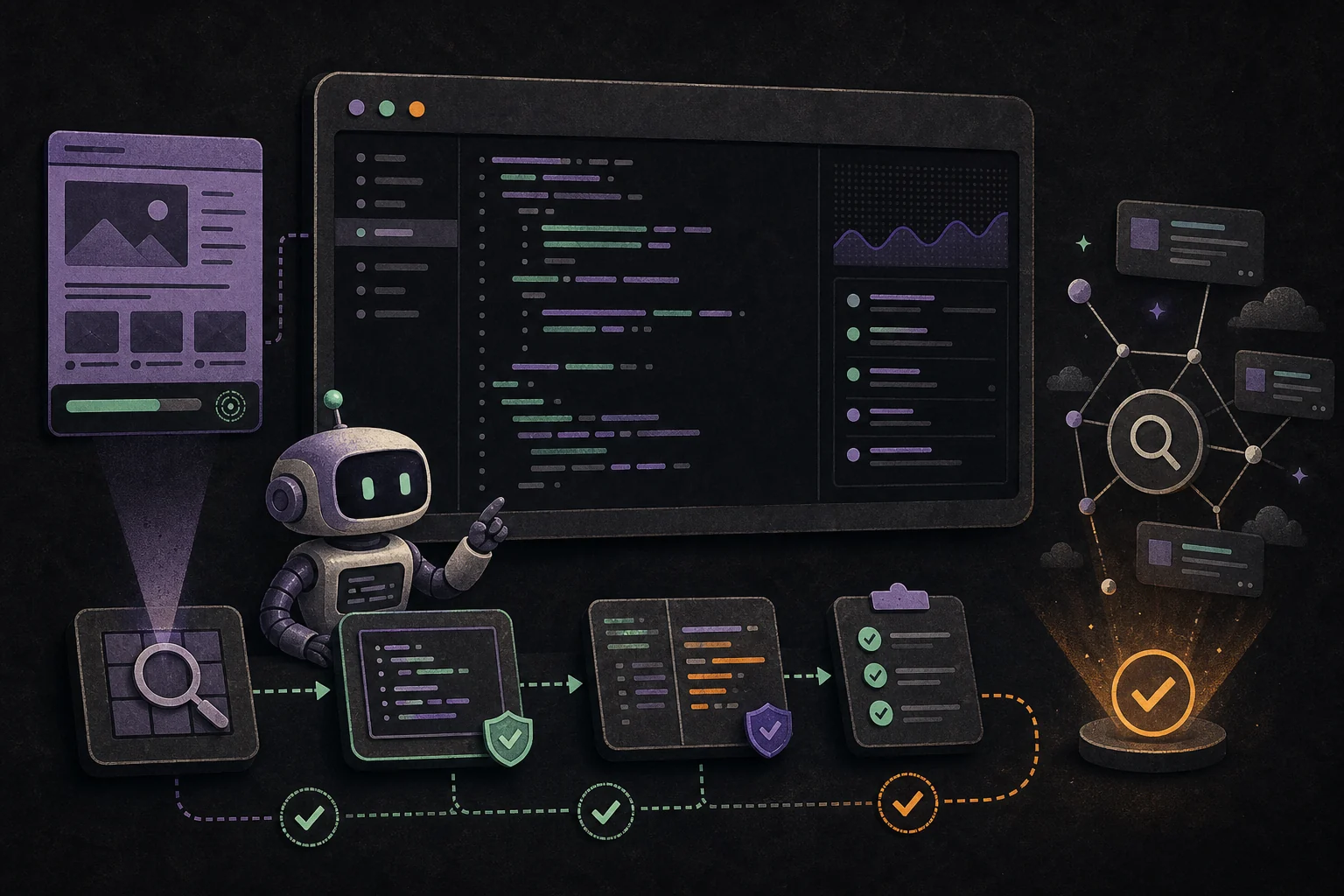
Claude Code SEO is a repository workflow: scan the live website, select one observed discovery or content issue, ask Claude Code to inspect the connected files, implement the smallest safe change, run relevant checks, deploy, inspect the production response, and rescan. Claude Code can edit the repository, but it cannot guarantee crawling, indexing, rankings, AI citations, or traffic.
This commercial hub connects TruboRankAI diagnosis with Claude Code implementation. It separates always-on project rules, reusable SEO skills, deterministic hooks, and one-off tasks so teams can fix crawlability, metadata, public routes, answer clarity, internal links, and machine-readable resources without uncontrolled repository-wide rewrites.
Repository code can look correct while production serves an old build, blocks crawlers, renders an empty shell, or publishes conflicting URL signals.
Small tasks make diffs reviewable and let you prove which deployment changed the observable website behavior.
Audit, AI visibility, research, content optimization, and reporting-organized around the website you are improving.
 TruboRankAI
Third-party names and logos are trademarks of their owners and are shown for comparison. Other-tool prices are illustrative monthly benchmarks; exact plans and costs may vary.
Choose the right instruction layer, fix dependencies in order, and verify the deployed result rather than accepting code output as proof.
Start from the live URL because search systems interact with the deployed response. Record the final status, redirect target, canonical, robots directives, visible heading, sitemap presence, internal links, and rendered explanation for the affected route. A repository inspection is useful only after the public failure is defined precisely.
Put permanent repository conventions in CLAUDE.md: architecture boundaries, public versus private routes, test commands, content truth rules, and files that must not be exposed. Anthropic documents CLAUDE.md as persistent project context. Keep it focused; a long SEO handbook loaded into every session can consume context and weaken adherence.
Use a Claude Code skill for a repeatable, judgment-based workflow such as turning an audit finding into a scoped task. The skill should define required inputs, inspection order, implementation constraints, validation, and the final evidence report. It should not hard-code invented keywords, prices, testimonials, or platform behavior.
Use hooks only for deterministic enforcement. A post-edit hook can run a formatter or syntax check, while a pre-tool hook can block a protected operation. Anthropic distinguishes hooks from skills: hooks fire at lifecycle events; skills provide instructions that Claude interprets. A prose warning is not equivalent to enforced protection.
Fix dependencies before enhancements. Access, successful responses, stable redirects, index controls, canonical consistency, direct-route rendering, and sitemap discovery come before schema polish or new content. Then improve the page-specific answer, evidence, limitations, internal links, and conversion path.
Treat the deployment as a separate stage. Run local checks, review the diff, deploy through the normal process, open the canonical route anonymously, inspect its output, and rescan. A passing local test does not prove that the CDN, framework adapter, host configuration, or cached production build behaves the same way.
Measure outcomes by stage. A crawler request is not indexing; indexing is not ranking; a search impression is not an AI citation; and a citation is not a visit or conversion. TruboRankAI helps identify and organize public readiness work, while external search and analytics systems provide later evidence.
It can implement repository changes, but it still needs accurate evidence, product facts, scope, review, deployment, and production verification.
Put short permanent repository rules in CLAUDE.md. Put a detailed repeatable audit-to-fix workflow in a skill so it loads only when relevant.
No. It can improve technical eligibility and page usefulness, but search and AI systems independently decide crawling, indexing, retrieval, ranking, and citation.
The workflow was reviewed on 2026-08-26 against current Claude Code documentation for project context, skills, hooks, and agent behavior, then mapped to observable TruboRankAI public scan stages. It separates implementation success from crawling, indexing, rankings, AI citations, referrals, and conversions.