






Route the finding to the right control plane.
Component and metadata changes belong in code; domain, protection, environment, and production assignment may belong in Vercel.
Find the live failure, correct it in v0 or Vercel, publish, and compare the same route.



Turn one verified production finding into a bounded v0 task.
Open the SEO Workspace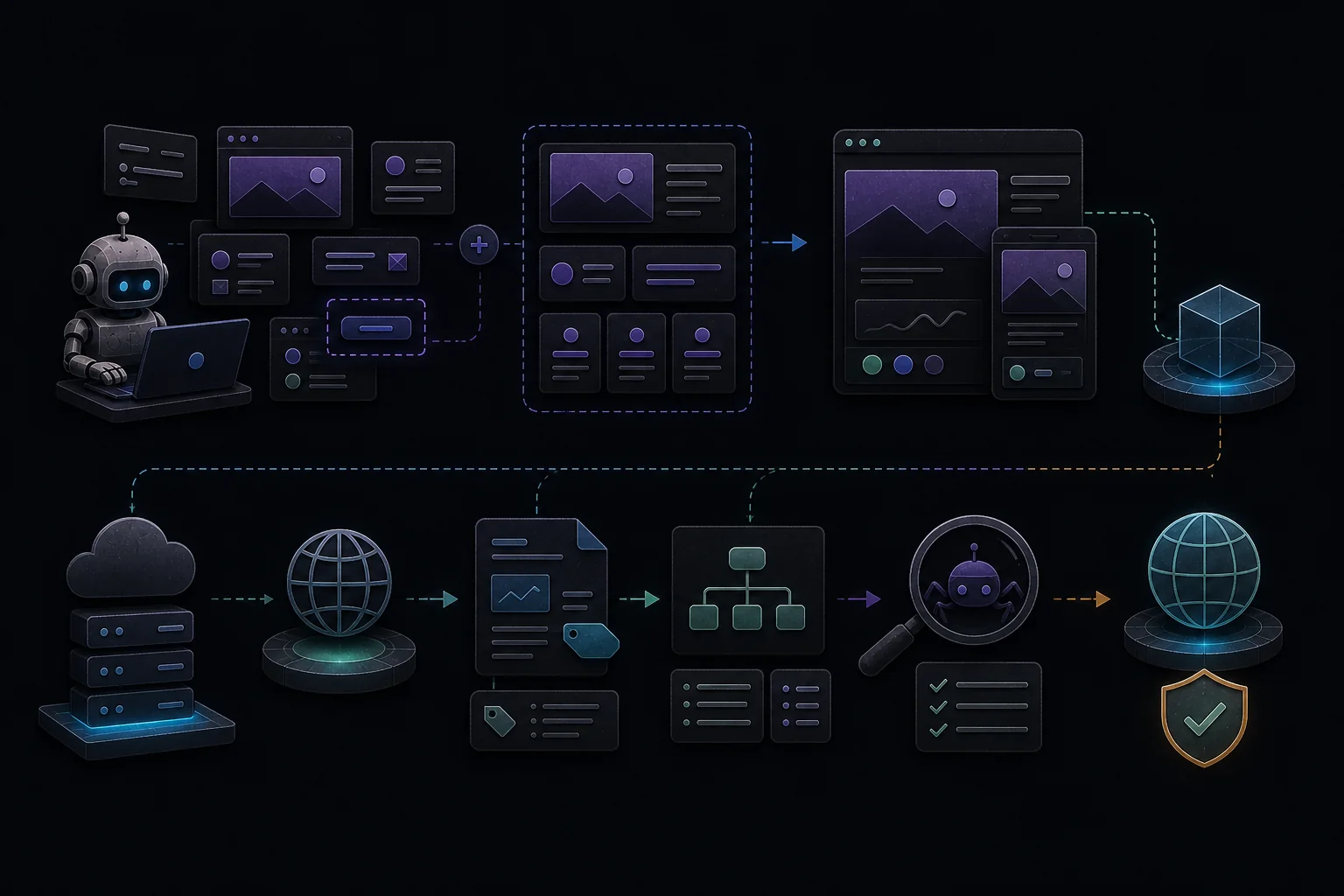
A v0 SEO checker should follow the canonical Vercel production URL and inspect public access, deployment protection, status and redirects, custom-domain consistency, preview duplication, robots directives, canonical, sitemap inventory, initial and rendered content, Next.js metadata, headings, internal links, invalid-route behavior, structured data, performance symptoms, AI crawler access, and answer quality. Fix production assignment, authentication, redirects, noindex, canonical conflicts, and missing server-visible content before adding schema or more routes.
This action page makes TruboRankAI the independent verification layer around a v0-generated Vercel project. It records public evidence and scopes a testable implementation prompt.
Component and metadata changes belong in code; domain, protection, environment, and production assignment may belong in Vercel.
v0 publishes applications to Vercel; advanced domain, environment, protection, and monitoring behavior belongs to the connected Vercel project.
Audit, AI visibility, research, content optimization, and reporting-organized around the website you are improving.
 TruboRankAI
Third-party names and logos are trademarks of their owners and are shown for comparison. Other-tool prices are illustrative monthly benchmarks; exact plans and costs may vary.
Verify access and canonical production before optimizing content details.
Start with the final destination. Follow the custom domain and generated URLs, confirm the latest production deployment, test without a Vercel session, and observe protection or login challenges. Preview success does not prove the production alias is current or public.
Check status and routing. Important routes should load directly and refresh without a rewrite error. Missing routes should return meaningful 404 behavior instead of a generic successful shell. Record redirect chains, trailing-slash variants, case differences, and duplicate hosts.
Inspect robots.txt, meta and HTTP robots directives, canonical, sitemap.xml, and Open Graph URLs. Confirm these use the preferred host, exclude private and preview routes, and cover the intended public inventory without redirects.
Compare initial source and rendered DOM. Check Next.js titles, descriptions, H1, product explanation, crawlable links, canonical, and structured data. Test whether asynchronous data, client components, or hydration errors remove meaningful content from the live route.
Evaluate usefulness and accuracy last. Every route should solve a distinct visitor task, include visible evidence and limitations, and make the next action clear. Generated UI labels and schema cannot replace original factual content.
Use v0 to implement components and code, but verify the connected Vercel production deployment independently. A polished chat preview does not prove the final domain, redirect, access policy, response status, source HTML, metadata, canonical, sitemap, or route behavior.
Keep public and private surfaces separate. Index useful marketing, feature, use-case, pricing, documentation, support, and policy routes. Protect account, dashboard, billing, API, webhook, preview, staging, test, and user-data routes, and exclude them from public sitemaps.
Publish the correction and repeat the original request on the canonical domain. Measure crawling, indexing, impressions, clicks, AI crawler visits, mentions, referrals, and conversions independently. v0, Vercel, Next.js, and TruboRankAI can improve readiness but cannot guarantee indexing, rankings, AI citations, or traffic.
No. It checks the public website; private dashboards are only needed to implement settings changes.
It can inspect the submitted URL and its redirects; confirm project assignment in Vercel when the alias is uncertain.
No. It identifies observable readiness problems; Google controls indexing and ranking.
Reviewed on 2026-08-26 against official v0 deployment, custom-domain, and quickstart documentation; official Next.js metadata and production guidance; and Google Search Central JavaScript and canonical documentation. Chat preview, Vercel production output, and later search outcomes are evaluated separately.