






Public visibility is a route decision.
A published app may still send anonymous visitors to login. Decide explicitly which pages explain the product before authentication.
Expose useful acquisition pages, protect private app data, and verify every production change.



Convert one verified live finding into a bounded Base44 task.
Open the SEO Workspace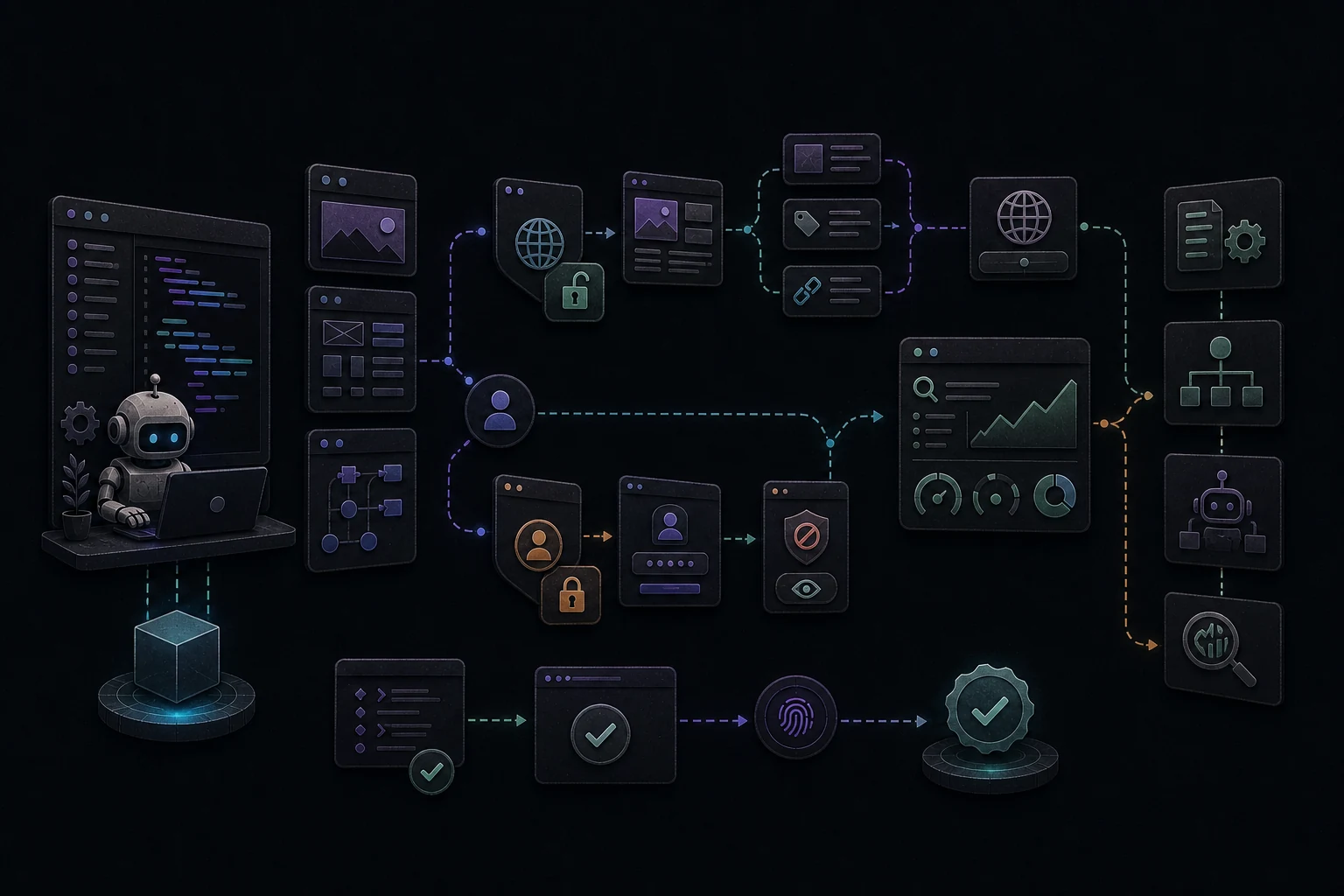
A reliable Base44 SEO workflow is: publish the app, decide which acquisition pages must be public without login, use a stable primary custom domain for production when available, enable and configure the platform SEO controls, write distinct per-page titles and descriptions, confirm robots, canonical, and generated sitemap URLs, compare initial and rendered content because Base44 documents client-side rendering as the default, add useful answer-focused copy and crawlable links, connect the matching Search Console property, fix one evidenced problem, republish, and rescan.
This commercial pillar separates Base44 publication, authentication boundaries, SEO/GEO dashboard controls, custom-domain ownership, client-side rendering, generated discovery files, Google indexing, content usefulness, and AI visibility outcomes.
A published app may still send anonymous visitors to login. Decide explicitly which pages explain the product before authentication.
Publishing, authentication rules, custom domains, SEO toggles, and client rendering can change what anonymous crawlers receive.
Audit, AI visibility, research, content optimization, and reporting-organized around the website you are improving.
 TruboRankAI
Third-party names and logos are trademarks of their owners and are shown for comparison. Other-tool prices are illustrative monthly benchmarks; exact plans and costs may vary.
Establish access and rendering first, then refine discovery, content, answer readiness, and measurement.
Map the public and private routes before optimizing. Test the homepage, feature, use-case, pricing, documentation, support, and legal pages in a private browser. Confirm acquisition pages return useful content without an account, while personalized and sensitive routes remain authenticated.
Choose a stable primary host. Base44 recommends a custom domain for production SEO. Test the platform host, apex, www, HTTP, and HTTPS; make alternates converge cleanly and ensure canonical plus sitemap URLs use the preferred domain.
Use Base44’s per-page metadata and indexing controls, then verify their live output. The platform documents generated sitemap, robots, and canonical support plus SEO/GEO checking. Compare the configured title and description with both page source and rendered DOM after every publish.
Account for client-side rendering. Google can render JavaScript, but meaningful source output and resilient links reduce crawler dependency. Inspect hydration, soft-404 behavior, route status, delayed content, and whether non-JavaScript agents can understand the product from machine-readable resources.
Build a compact public information architecture. Every page should answer a distinct visitor problem, show evidence and limitations, link to the next useful step, and avoid thin keyword-swapped variants. Use llms.txt or AI discovery features as navigation aids, not substitutes for accessible pages.
Connect Search Console to the exact primary host and submit the canonical sitemap. Diagnose discovery, crawl, rendering, and canonical messages with URL Inspection. Request indexing only after the public route and its content are corrected.
Use Base44’s SEO and GEO dashboard for platform-native configuration and recommendations, then inspect the published anonymous URL independently. A dashboard cannot by itself prove the live response, redirects, canonical host, sitemap inventory, source HTML, rendered content, or authentication behavior.
Separate acquisition from application data. Public product, use-case, pricing, documentation, support, and policy pages may be searchable. Account, dashboard, billing, API, webhook, private workspace, test, staging, and user-data routes should stay gated and out of public sitemaps.
Finish with a publish-and-rescan loop. Measure discovery, indexing, impressions, clicks, AI crawler activity, mentions, citations, referrals, and conversions separately. Base44 controls can improve readiness, but Base44 and TruboRankAI cannot guarantee indexing, ranking, AI citation, or traffic.
Yes. Base44 documents SEO/GEO checking, per-page metadata and visibility controls, sitemap, robots, canonical, and AI discovery features.
Private product routes can require login, but public acquisition pages need anonymous access if they are intended for search.
No. Platform controls improve readiness; Google decides crawling, canonical selection, indexing, and ranking.