





A working build is not a discovery strategy.
AI builders accelerate implementation, but the deployed website still needs stable public routes, correct index signals, useful answers, and connected pages.
Scan the live AI-built website, find crawl and content gaps, and turn the evidence into focused SEO, AEO, and GEO implementation work.



Move from a generated build to an evidence-backed visibility workflow.
Open the Vibe SEO Workspace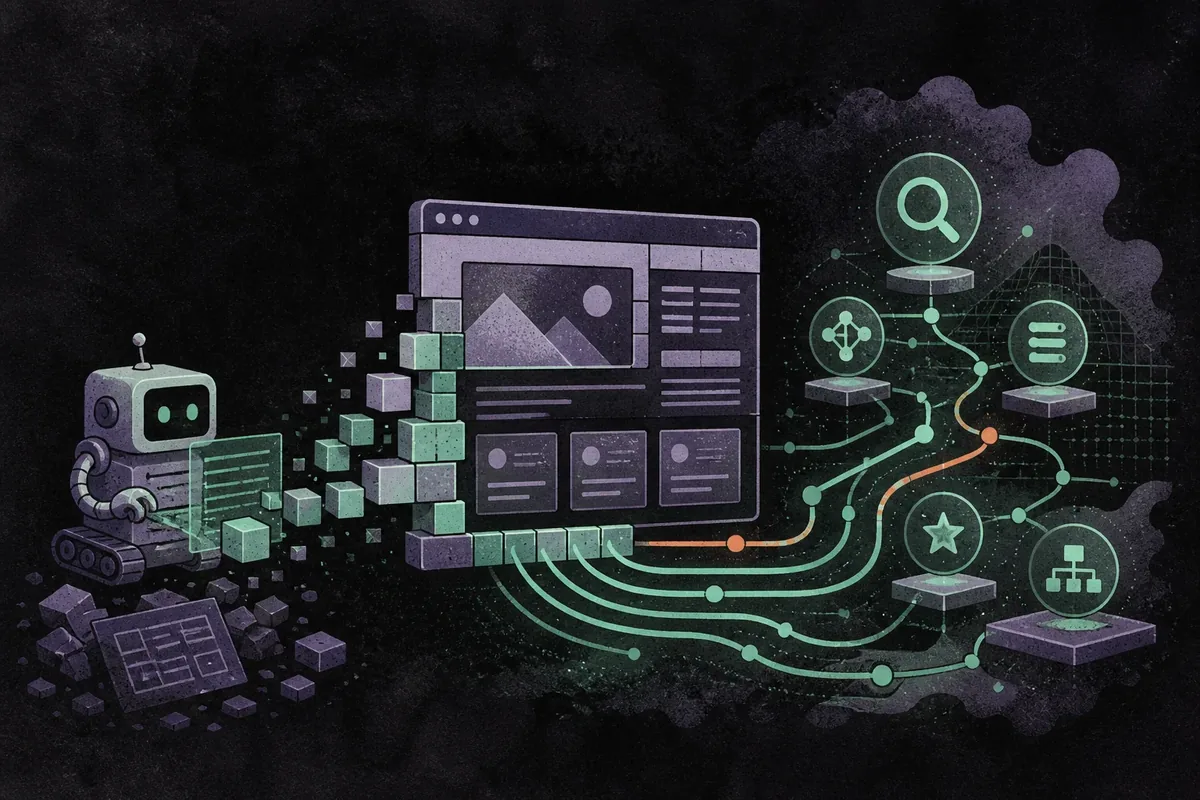
SEO for an AI-built website, AI-generated website, or AI project is the same production-first discipline described here as Vibe Coding SEO: verify the live host, separate public acquisition pages from the private application, fix access and index controls, establish canonical URLs and sitemap discovery, expose useful server-visible content, create distinct pages for real visitor tasks, connect them with contextual links, and measure search, crawler, referral, and conversion evidence separately. These wording variants are consolidated on one canonical hub to prevent overlapping pages.
This page is the commercial hub for owners and developers of AI-built websites. It explains the scan-to-fix workflow across SEO, answer clarity, generative-engine readiness, launch verification, and measurement. It does not claim that a scan, schema block, llms.txt file, or AI-crawler visit guarantees rankings or recommendations.
AI builders accelerate implementation, but the deployed website still needs stable public routes, correct index signals, useful answers, and connected pages.
Use the live report to fix the highest dependency, deploy it, and verify the production response before expanding the content cluster.
Audit, AI visibility, research, content optimization, and reporting-organized around the website you are improving.
 TruboRankAI
Third-party names and logos are trademarks of their owners and are shown for comparison. Other-tool prices are illustrative monthly benchmarks; exact plans and costs may vary.
Use the detailed guide after the live scan to understand what the evidence means, which layer should be fixed first, and what no audit can guarantee.
Vibe coding compresses the build cycle, but it also makes unfinished acquisition layers easy to overlook. A polished interface can sit behind client-side routing, reuse the same metadata on every path, expose only a few sentences of public copy, or publish preview-domain URLs in its sitemap. The correct object to audit is the deployed website, not the prompt history or the apparent quality of the generated components.
Begin by separating public acquisition pages from the application. The homepage, feature explanations, use cases, pricing context, documentation, comparisons, and support guides may be indexable when they help a visitor. Account screens, dashboards, APIs, webhooks, checkout steps, staging hosts, and user data should remain private. More indexable URLs are not automatically better; a smaller coherent site is easier to maintain and understand.
Next, test how every important route behaves when opened directly in a private window. Record the final status, redirect target, canonical URL, robots directives, title, main heading, visible explanation, and crawlable links. AI-built single-page applications often appear functional during internal navigation while a direct refresh returns a fallback, a blank shell, or the wrong canonical. Server-rendered or reliably pre-rendered acquisition content reduces that risk.
Give each public page one job. A product hub explains the audience, problem, workflow, capabilities, limits, and next action. A checker page serves someone ready to test a URL. A troubleshooting guide helps diagnose a specific failure. A platform page should include platform-specific evidence rather than replacing a brand name in generic copy. This intent separation is how the cluster covers long-tail demand without competing with itself.
SEO foundations and AI-search readiness overlap but are not identical. Search engines need accessible pages, consistent URL signals, useful content, and links. Answer engines benefit from direct answers, clear entities, explicit limitations, and passages that stand on their own. Generative systems may use search indexes, partner indexes, live retrieval, or their own crawlers. No single file or schema type controls all of those paths.
TruboRankAI connects diagnosis to implementation. Run the public scan, inspect the failed checks and affected URLs, then pass a small evidence-backed task to the coding agent. Verify the deployed response and rescan before moving to the next layer. Pro workflows can add deeper context and coding-agent prompts, but the free diagnosis should still identify the most important public blockers.
After launch, measure stages separately. Search Console impressions indicate Google search exposure, not AI citations. Verified crawler logs indicate requests, not recommendations. Referral analytics indicate visits that carried a source, not every influence on discovery. Use these signals to decide whether the next task is technical access, stronger content, internal linking, distribution, or conversion improvement.
The fundamentals are the same, but AI-generated projects commonly need extra attention to client-side routing, generated metadata, preview domains, thin acquisition copy, and the boundary between public pages and private app routes.
It diagnoses public signals and provides implementation context. A developer or coding agent still needs repository access, safe constraints, deployment, and verification.
No. Create a URL only for a distinct intent. Closely related phrases should be answered on the strongest existing page to avoid overlap and maintenance debt.
The workflow maps official Google crawl, JavaScript, sitemap, canonical, and people-first content guidance to recurring launch risks in AI-built websites. Product claims are limited to capabilities visible in the current TruboRankAI scan and report workflow. Reviewed on 2026-08-26; rankings, indexing, AI citations, and traffic are not guaranteed.