
Antigravity Free Trial for Vibe Coders
People searching for Antigravity free trial or Antigravity Free Trail are usually comparing AI coding tools before choosing a workflow for a real build.
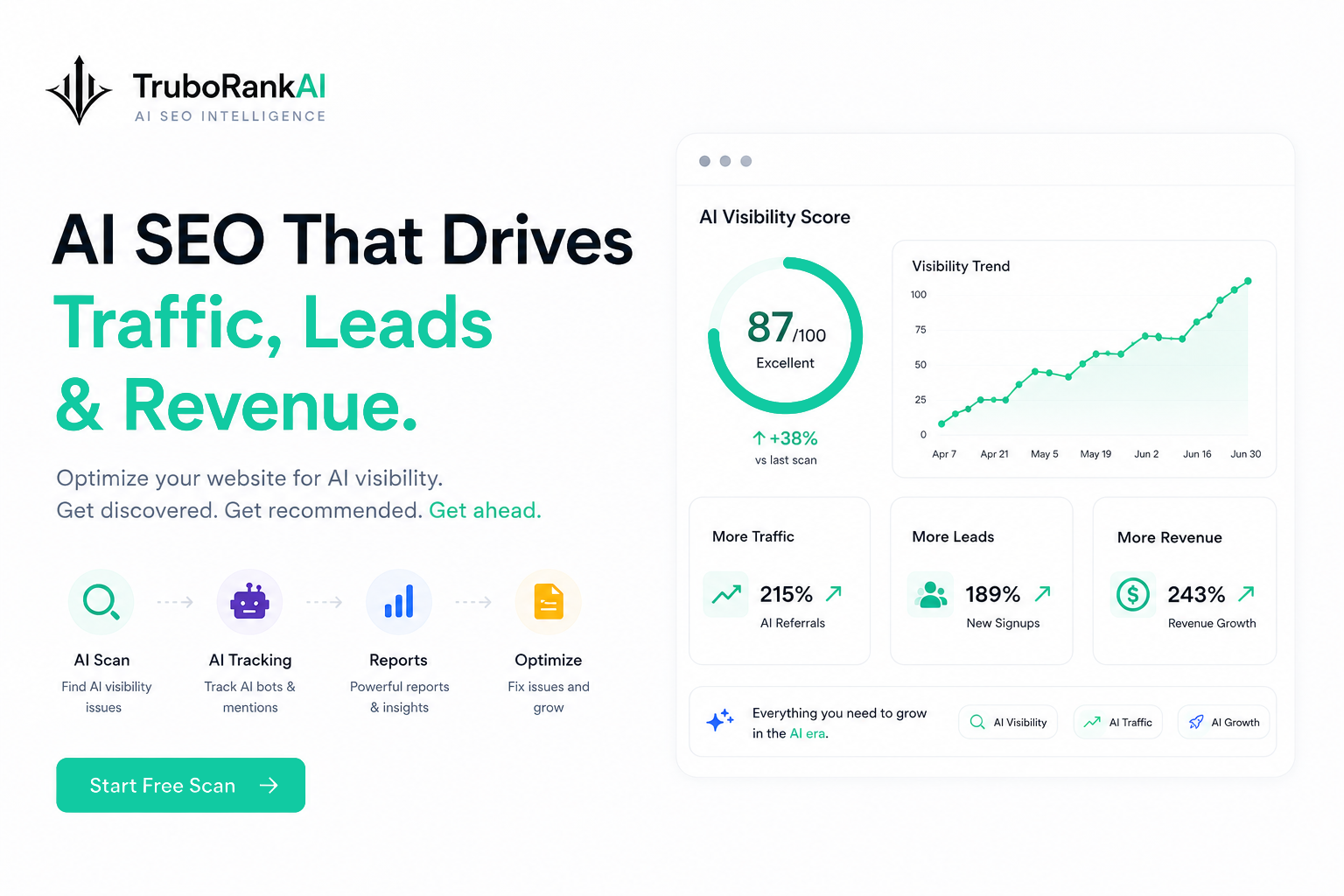
An Antigravity free trial search shows high intent around AI coding tools, agentic development, and vibe coding workflows. Before committing to any AI coding assistant, test it on a real website task and then use TruboRankAI to check whether the shipped project is ready for SEO, AEO, GEO, AI crawler access, and AI search visibility.
This guide targets Antigravity Free Trial, Antigravity Free Trail, Antigravity AI free trial, AI coding assistant trial, and vibe coding tools free trial. It explains how to evaluate an AI coding workflow and why TruboRankAI is the visibility layer for AI-built websites.
Quick Questions
Some users misspell trial as trail. Covering both helps match real long-tail search behavior without changing the article meaning.
Test repository understanding, multi-file edits, debugging, UI changes, SEO implementation, and safe verification.
If the tool helps you ship, scan the live site with TruboRankAI to find visibility gaps before you market it.
Check your website's AI discoverability signals.
Run a free scan for robots.txt, sitemap discovery, Link headers, Markdown readiness, and AI bot access.
Main Explanation
Antigravity Free Trial and Antigravity Free Trail searches belong to the broader AI coding assistant trial category. Users want to know whether a tool can help them build faster, replace manual boilerplate, understand repositories, and move from idea to launch without hiring a full engineering team.
For vibe coders, the best way to evaluate any AI coding tool is to give it a task with business value. Do not only ask it to build a todo app. Ask it to create a landing page, improve onboarding, fix a checkout bug, add a pricing FAQ, generate schema, update sitemap logic, or improve a product page.
The AI coding assistant market changes quickly, so trial pages should avoid fake guarantees and outdated claims. A practical evaluation focuses on what you can test: editor experience, context window, repository search, code diffs, safety, cost, speed, and how easily the tool accepts precise instructions.
A strong trial should include SEO implementation work because most AI-built projects need discoverability. If the assistant can build but cannot help expose public pages, improve metadata, write answer sections, update sitemap entries, and avoid private routes, the workflow is incomplete.
AEO matters because AI search users ask direct questions. Your vibe-coded project should answer what it does, who it helps, how pricing works, how it compares, what problem it solves, and what steps a user should take. These answers should be visible in page text, not hidden in images or scripts.
GEO matters because generative AI systems need context across pages. Your homepage, feature pages, blog posts, docs, pricing page, and comparison pages should connect into a clear source network. Internal links help both users and crawlers understand the product.
TruboRankAI fits after the trial build. Publish the project, scan the public URL, review robots.txt, sitemap discovery, AI bot access, Link headers, Markdown readiness, AEO sections, and GEO structure, then ask your coding assistant to implement the prioritized fixes.
The best AI coding trial outcome is not only a working app. It is a working app with discoverable pages, clear answers, useful internal links, machine-readable resources, and a path toward customer acquisition from search and AI discovery.
Why this matters for AI search
Antigravity Free Trial for Vibe Coders matters because AI systems do not only look for keywords. They need accessible pages, clear explanations, stable source URLs, and passages that answer user intent directly.
When your content is easier to crawl and easier to summarize, it may become a better source candidate for answer engines and AI assistants.
Common mistakes to avoid
- Writing long introductions before answering the actual question.
- Hiding important content behind scripts, tabs, or gated UI.
- Publishing technical files once and never maintaining them.
- Using vague headings that do not match user questions.
- Forgetting internal links to related AI visibility topics.
Practical Steps
- Use the trial on a real website or SaaS repo.
- Ask the tool to inspect files before editing.
- Create or improve public pages for homepage, features, pricing, docs, and FAQs.
- Add direct answers for long-tail buyer prompts.
- Check whether the tool can safely handle sitemap, robots.txt, metadata, and schema tasks.
- Run TruboRankAI after deployment.
- Feed the scan findings back into the AI coding assistant as focused implementation tasks.
Practical example
A strong AI-ready page usually starts with a direct answer, then explains the context, then lists practical steps, examples, and related resources. This makes the page useful for humans while also giving AI systems cleaner passages to extract.
For example, if a page explains an optimization concept, it should define the concept, explain why it matters, show how to test it, describe common mistakes, and link to related implementation pages.
Recommended page structure
- Start with one clear H1 that matches the topic.
- Add a Quick Answer section near the top.
- Use an AI Summary section for concise machine-readable context.
- Break instructions into short steps and examples.
- Add FAQ questions that reflect real search and AI assistant prompts.
- Link to related pages so crawlers can understand the content cluster.
FAQ
Is Antigravity Free Trail a typo?
Yes, many users mean Antigravity Free Trial. This page includes both forms because search behavior often includes misspellings.
Should I choose an AI coding tool only by trial length?
No. Trial length matters less than whether the tool helps you ship safe code and improve discoverability.
How does TruboRankAI help after an AI coding trial?
It scans the public website for AI visibility, SEO, AEO, GEO, crawler access, and machine-readable signal gaps.