




Published and public are prerequisites.
A private project, login-gated homepage, or editor preview is not a crawlable acquisition page even when it works for the owner.
Use one primary domain, useful public pages, live crawl evidence, and a post-release verification loop.



Turn one verified live finding into a bounded Lovable task.
Open the SEO Workspace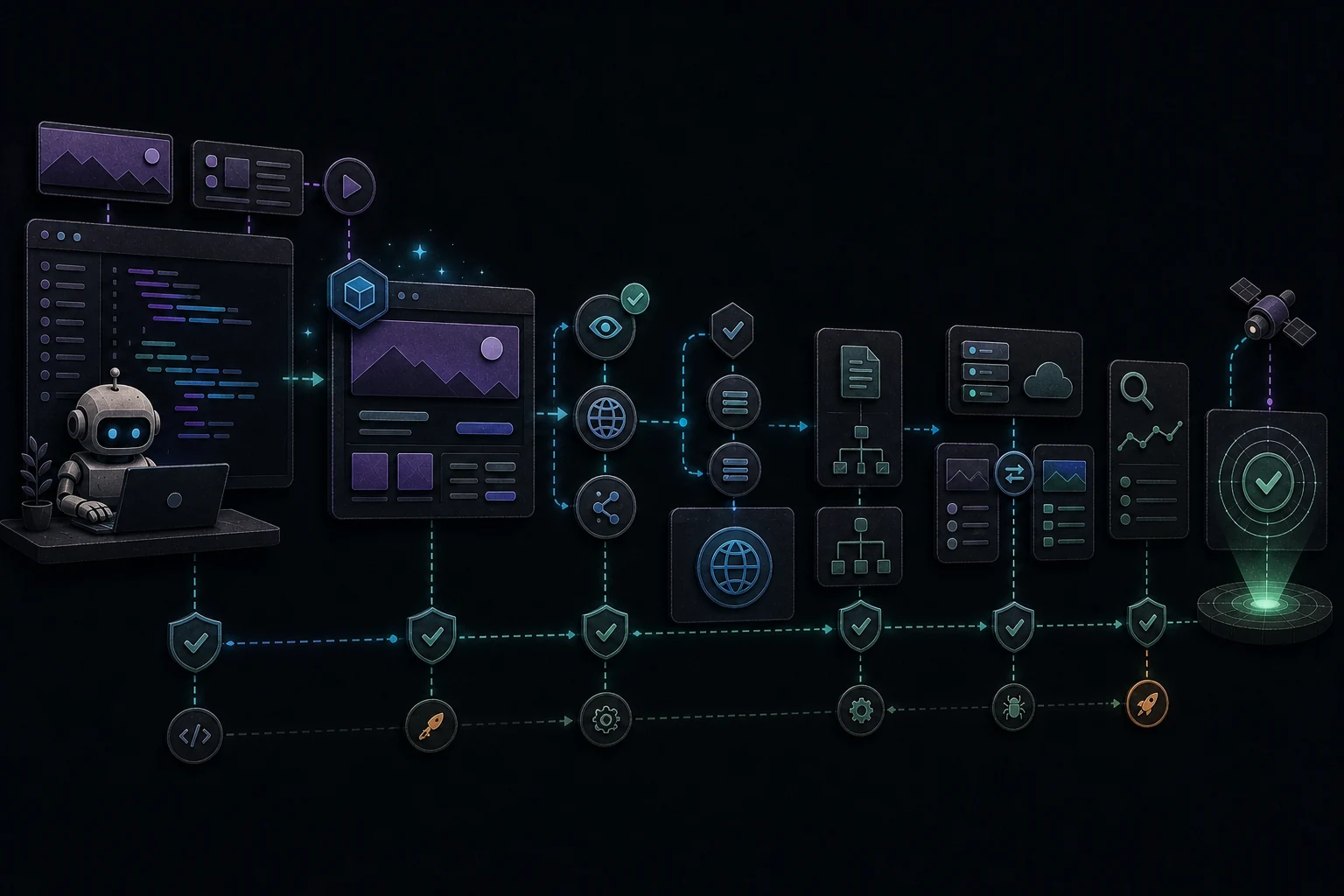
A reliable Lovable SEO workflow is: make the acquisition pages public, publish the project, choose and verify one primary domain, provide a unique title and description, ensure useful page text and crawlable links are available, confirm the final canonical and sitemap, run Lovable’s SEO and AI search review, inspect the same URL independently, connect the correct Search Console property, submit the canonical sitemap, fix one evidenced issue, republish, and rescan. Treat the builder review as guidance rather than an indexing guarantee.
This commercial pillar covers the full Lovable launch-to-search workflow. It separates editor preview, published lovable.app URL, primary custom domain, live HTML and rendering, Google discovery, content usefulness, AI-search readiness, and delayed performance outcomes.
A private project, login-gated homepage, or editor preview is not a crawlable acquisition page even when it works for the owner.
Publishing, connecting a custom domain, changing the primary host, or updating the app can change the public response and discovery signals.
Audit, AI visibility, research, content optimization, and reporting-organized around the website you are improving.
 TruboRankAI
Third-party names and logos are trademarks of their owners and are shown for comparison. Other-tool prices are illustrative monthly benchmarks; exact plans and costs may vary.
Establish the public host and useful content first, then refine metadata, discovery, answer readiness, and measurement.
Start with publication and visibility. Open the final page in a private browser session and confirm it returns a successful response without an editor token, workspace permission, or login redirect. An application can keep its product experience private while exposing a separate public homepage, features, pricing, use cases, documentation, and legal pages.
Choose one primary host. Lovable supports default published URLs and custom domains, while its domain settings can designate a primary domain and redirect alternates. Confirm apex, www, and the lovable.app version resolve consistently and that the page canonical and sitemap use the same preferred host.
Review the response before adding more content. Compare initial HTML with the rendered page for title, description, canonical, H1, product explanation, direct answers, crawlable links, and structured data. Google can render JavaScript, but meaningful server or prerendered output reduces dependence on delayed rendering and helps bots that do not execute scripts.
Build a small public information architecture. Create distinct pages only for genuine user needs: product overview, feature, audience or use case, pricing, alternatives, documentation, help, and policies. Each page should answer its own question, link to the next action, and avoid being a keyword-swapped copy of another route.
Connect Search Console to the exact primary URL and submit the canonical sitemap. Use URL Inspection to diagnose discovery, crawl, render, and canonical messages. Request indexing after the page is fixed and publicly testable rather than repeatedly submitting a blocked or thin URL.
Use the Lovable editor and documented SEO review as implementation aids, but verify their output on the final anonymous URL. A dashboard score cannot prove the status, HTML, canonical, redirect, sitemap, or rendered content served by the production host after a release or domain change.
Protect application boundaries. Public acquisition pages, documentation, legal pages, and support content can be indexed when useful. Dashboard, account, private workspace, billing, API, webhook, staging, test, and user-data routes should remain outside public sitemaps and visible search content.
Finish by publishing the change and repeating the original public scan. Track discovery, indexing, impressions, AI crawler activity, mentions, referrals, and conversions independently. Lovable features can improve implementation readiness, but neither Lovable nor TruboRankAI can guarantee Google indexing, rankings, AI recommendations, or traffic.
Yes. Lovable documents publish settings, SEO and AI search review, metadata, custom domains, sitemap help, and Search Console workflows. Verify the live result.
A default published URL can be public, but a stable primary custom domain improves brand control and canonical consistency when the plan supports it.
Lovable documents Search Console and sitemap assistance, but Google still decides crawling, canonical selection, indexing, and ranking.
Reviewed on 2026-08-26 against Lovable’s official SEO and AI search, publishing, and custom-domain documentation plus Google Search Central JavaScript, canonical, and sitemap guidance. Editor settings, deployment, public crawl evidence, and later search outcomes are separated.