





Monitoring starts with a baseline.
Save the production state before a major release so later differences in access, metadata, discovery, or content have a dated comparison point.
Connect the production site, preserve scan history, add matching GSC and crawler evidence, and investigate changes without guessing.



Use changes in readiness, Google performance, and crawler activity to choose the next bounded task.
Open the Vibe SEO Workspace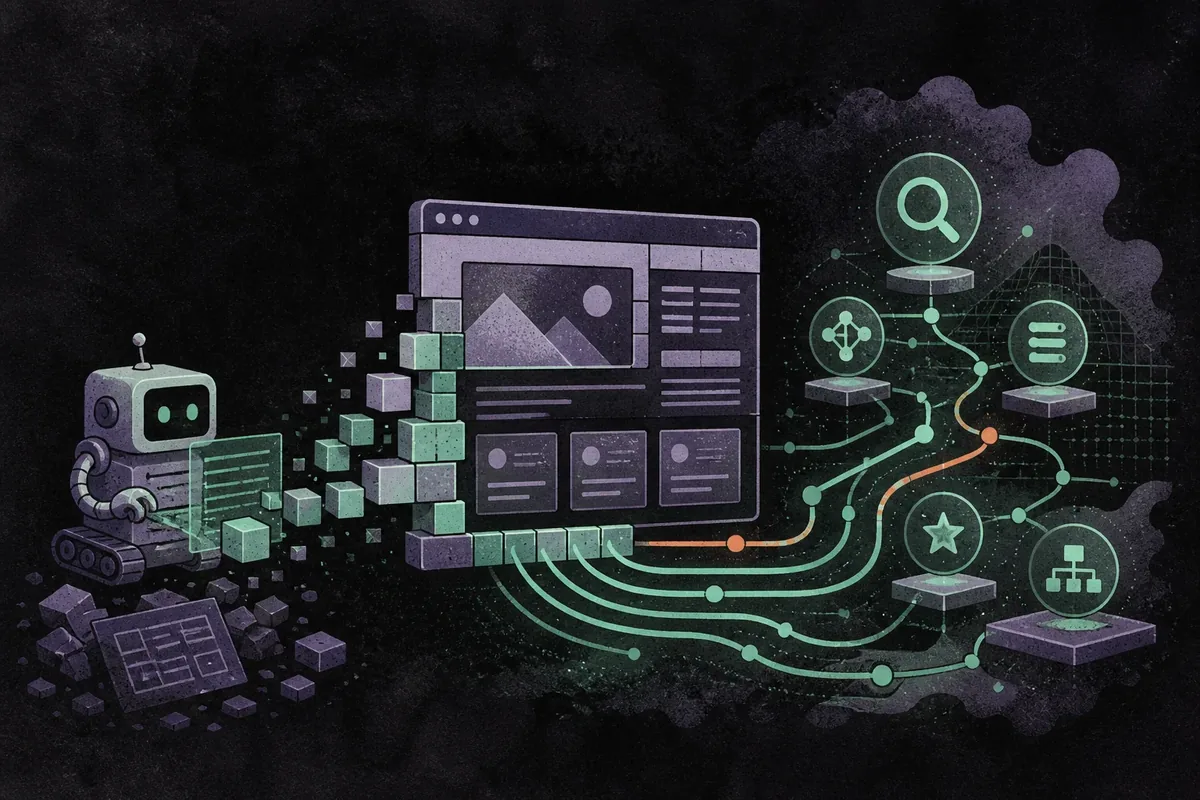
A practical Vibe-coded website search monitor combines repeatable production scans with connected Google Search Console data for queries, pages, clicks, impressions, CTR, and average position, plus installed Bot Tracking for supported AI and search crawler requests, top crawled pages, and last-seen evidence. TruboRankAI provides these sources for eligible connected workflows, but it does not claim universal rank tracking, complete AI citation coverage, or data when a property or tracker is not connected.
This subscription-intent page defines monitoring truthfully as three evidence streams: saved readiness state, Google performance for an owned matching property, and supported crawler events for an owned configured site.
Save the production state before a major release so later differences in access, metadata, discovery, or content have a dated comparison point.
If GSC is disconnected, mismatched, or empty—or tracking has no configured verified events—the monitor should show that state instead of inventing metrics.
Audit, AI visibility, research, content optimization, and reporting-organized around the website you are improving.
 TruboRankAI
Third-party names and logos are trademarks of their owners and are shown for comparison. Other-tool prices are illustrative monthly benchmarks; exact plans and costs may vary.
Investigate a change at the layer that observed it, then verify the production correction.
Use saved production scans for configuration and content readiness. Compare access, redirects, robots controls, canonicals, sitemap, page structure, internal links, and AI-readable resources after meaningful deployments. A readiness change explains the website state, not the search engine reaction.
Use the matching owned Search Console property for Google performance. Review query and page trends, clicks, impressions, CTR, average position, countries, and devices in their defined date range. A movement can suggest where to investigate, but average position is not a fixed rank and GSC does not provide complete cross-platform AI visibility.
Use installed supported Bot Tracking for automated request evidence. Review AI and search crawler events, bot names and classifications, reached paths, totals, and last seen data according to the tracker coverage. Keep verified or detected crawler events separate from human referrals, citations, and model-training claims.
Create an annotation discipline. Record launches, domain changes, robots or WAF changes, migrations, content updates, outages, and tracking changes. When a signal moves, compare affected URLs and time windows, inspect the owning layer, and avoid attributing causation from a coincidental chart movement.
Keep the public acquisition layer separate from the application. Useful marketing, feature, audience, pricing, documentation, comparison, support, and policy pages may be indexable. Account, dashboard, billing, checkout, API, webhook, admin, staging, preview, test, and user-data routes should remain protected and outside public sitemaps and machine-readable inventories.
Map every finding to its owner before editing. Routes and metadata may belong to the framework, content may come from a CMS, redirects and headers may be controlled at the server or edge, and domains may belong to the hosting platform. Ask a coding agent for the smallest bounded correction, preserve unrelated behavior, run syntax and project tests, deploy, and repeat the exact production request.
Measure stages separately after release. A successful scan is readiness evidence, Search Console reports Google discovery and performance, infrastructure tracking records supported crawler requests, analytics records attributed visits, and controlled observations or provider reports record AI appearances. None of these signals guarantees indexing, ranking, citation, recommendation, traffic, or conversion.
It uses connected Search Console evidence for the matching property; it is not described as a universal live rank tracker.
No. It records supported crawler requests. Citations and referrals need separate evidence.
The workflow should state that exact data is unavailable and continue from the scan evidence instead of inventing metrics.
Reviewed on 2026-08-26 against official Google developer, JavaScript, sitemap, canonical, URL Inspection, structured-data, and PageSpeed guidance plus OpenAI crawler documentation. Product claims are limited to the current TruboRankAI scan, GSC, Bot Tracking, and implementation workflow; no outcome is guaranteed.