






A code change is not production evidence.
The repository may contain the correct route or metadata while the deployed host serves an older build, a redirect conflict, or an empty client-side shell.
Start from the live site, preserve repository guardrails, implement the smallest correct change, then review and verify production.




Turn an observed public failure into a bounded Codex work item.
Open the SEO Workspace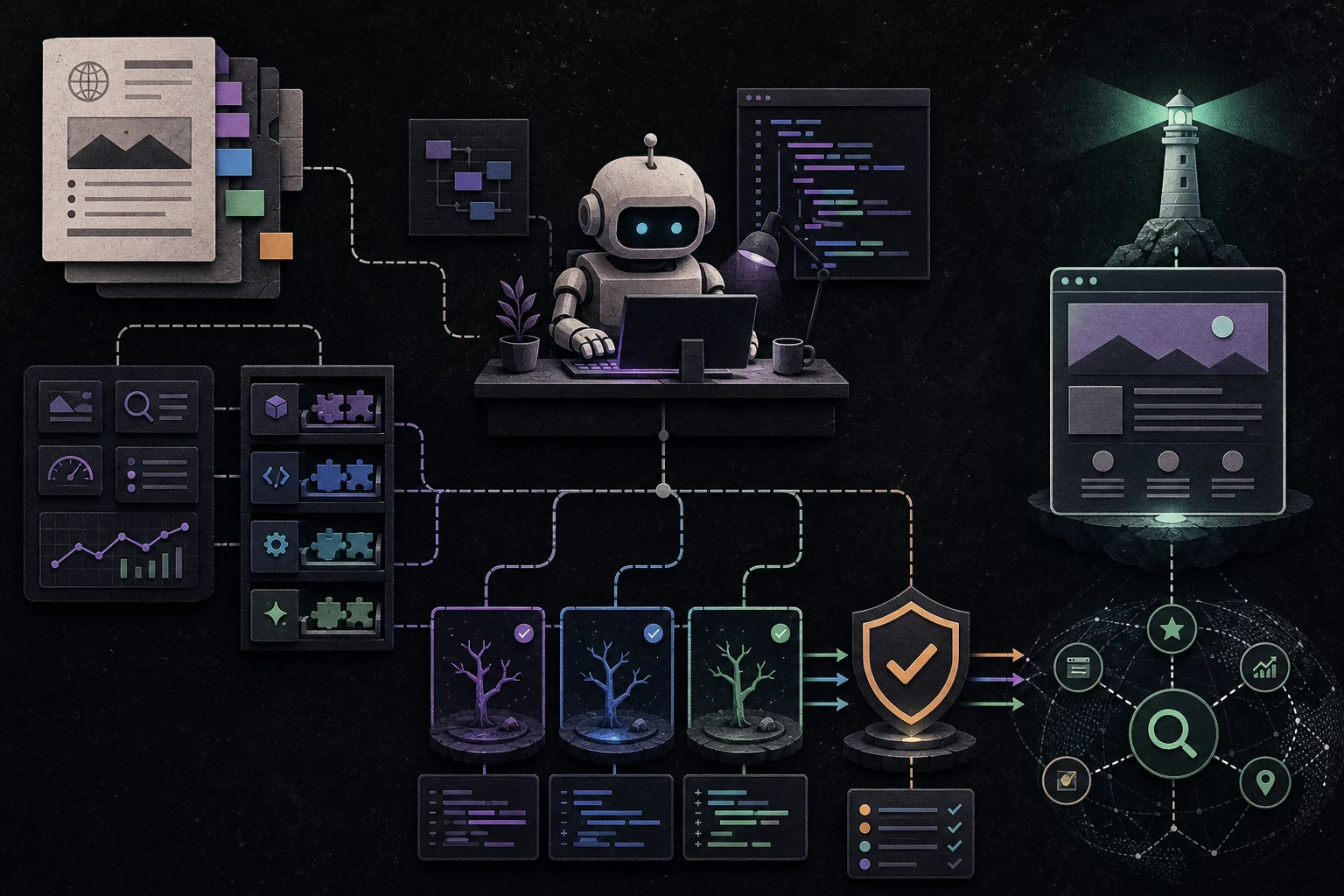
Codex SEO is a controlled repository workflow: scan the production website, identify one observable issue, place durable project rules in AGENTS.md, invoke the relevant SEO skill, let Codex inspect connected files, approve a bounded change, run proportional checks, review the diff, deploy, and rescan the public route. Codex can implement and review code, but it cannot guarantee crawling, indexing, rankings, AI citations, or traffic.
This commercial hub connects TruboRankAI evidence with Codex implementation. It explains what belongs in AGENTS.md, what belongs in a reusable skill, what stays in the task prompt, and what must be verified after deployment. The workflow applies to technical SEO, answer clarity, internal links, structured data, sitemap coverage, and public-route readiness.
The repository may contain the correct route or metadata while the deployed host serves an older build, a redirect conflict, or an empty client-side shell.
Keep permanent project boundaries in AGENTS.md, reusable audit logic in a skill, and the current URL and failure in the task itself.
Audit, AI visibility, research, content optimization, and reporting-organized around the website you are improving.
 TruboRankAI
Third-party names and logos are trademarks of their owners and are shown for comparison. Other-tool prices are illustrative monthly benchmarks; exact plans and costs may vary.
Define the public failure, map the project, protect user work, review the diff, and separate local completion from deployed and external outcomes.
Begin with the canonical live URL. Record the final response status, redirects, robots directives, canonical URL, sitemap state, visible heading, page explanation, structured data, and crawlable links. Write the observed behavior and expected behavior before Codex reads the repository. This keeps implementation tied to a verifiable public problem.
Use AGENTS.md for durable repository agreements. OpenAI documents that Codex reads these files before work and layers guidance from global and project scopes toward the current directory. Store architecture rules, protected routes, test commands, content truth requirements, and release conventions there. Do not embed one incident or a temporary keyword list as permanent guidance.
Use a skill for a reusable audit-to-fix procedure. OpenAI documents skills as directories containing a required SKILL.md plus optional scripts, references, and assets. The skill should define its trigger, required evidence, inspection sequence, safe edit boundary, validation, and handoff. Keep provider facts in cited references that can be reviewed independently.
Keep the current task specific. Include the affected URL, scan evidence, expected output, allowed files or systems, protected areas, and definition of done. Ask Codex to inspect connected routes, renderers, content sources, metadata, sitemap logic, styles, and tests before proposing a change. A broad request to improve all SEO makes review and attribution harder.
Fix dependencies in order. Anonymous access, successful responses, stable redirects, index controls, canonical consistency, direct-route rendering, sitemap discovery, and internal navigation come before schema polish or content expansion. Then improve direct answers, supporting evidence, limitations, entity clarity, related links, and conversion actions.
Use the review step as a separate control. Codex can report prioritized findings against changes without modifying the working tree during review. Read the complete diff, reject unrelated churn, verify that existing user edits remain intact, and confirm that no private route, secret, account flow, API, webhook, or user data became public.
Deploy through the normal release path and inspect the public response again. Local syntax and browser checks prove only local behavior. CDN caching, environment variables, routing adapters, DNS, redirects, and host configuration can change production output. Rescan the exact route with the same evidence criteria.
Measure later stages separately. Search Console impressions are not AI citations; verified crawler requests are not rankings; referrals are not every form of discovery; and a conversion does not prove one code change caused the outcome. Preserve dates and baselines so conclusions stay proportional.
Yes, when the repository is in scope and the task includes evidence, boundaries, relevant files, tests, and production verification.
No. Keep permanent repository agreements there. Put reusable task procedures in skills and the current URL and finding in the task prompt.
No. It can improve technical eligibility and usefulness, while search and AI systems independently decide crawling, indexing, ranking, retrieval, and citation.
Reviewed on 2026-08-26 against official OpenAI Docs for Codex CLI, AGENTS.md discovery, skills, and review behavior, then mapped to the current TruboRankAI public scan workflow. Local implementation, deployed behavior, crawling, indexing, visibility, citations, referrals, and conversions are treated as separate evidence stages.