






Choose context by purpose.
Persistent rules protect the repository, skills encode repeatable methods, and the current prompt carries today’s URL and evidence.
The tool can change. The diagnosis, safety boundary, acceptance checks, and production proof should remain stable.




Give the agent the smallest useful SEO implementation scope.
Open the SEO Workspace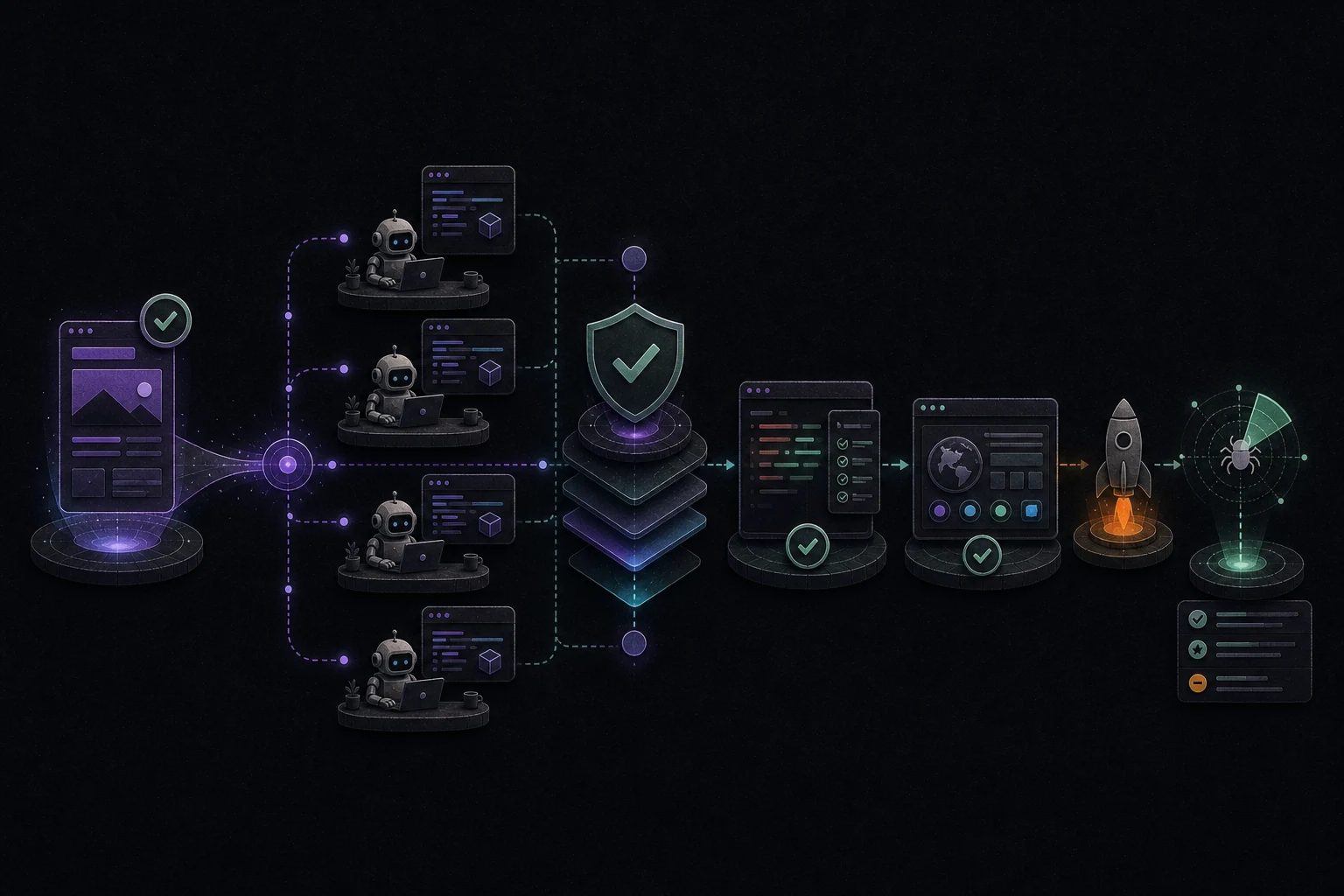
SEO for coding agents means using an agent to implement a verified website correction, not asking it to manufacture rankings. Start with a production scan, select one failure, load durable repository guardrails, provide the exact URL and evidence, require connected-file discovery before edits, approve tools in proportion to risk, test the affected route, review the complete diff, deploy normally, and rescan production. Choose a plain task for one incident, a reusable prompt for repeated inputs, a skill for a multi-step procedure, and MCP only when fresh external data or actions are genuinely needed.
This pillar provides a vendor-neutral operating model for Claude Code, Codex, GitHub Copilot, Cursor, Gemini CLI, Windsurf, and other agents. It separates task prompts, persistent instructions, skills, MCP tools, repository validation, deployment, and later search or AI visibility evidence.
Persistent rules protect the repository, skills encode repeatable methods, and the current prompt carries today’s URL and evidence.
Repository output and local tests are inputs. Verify the deployed anonymous URL before reporting the issue as resolved.
Audit, AI visibility, research, content optimization, and reporting-organized around the website you are improving.
 TruboRankAI
Third-party names and logos are trademarks of their owners and are shown for comparison. Other-tool prices are illustrative monthly benchmarks; exact plans and costs may vary.
Standardize the evidence and review process instead of depending on one agent’s interface.
Start with an observation the agent did not invent. Capture the public route, final response, redirects, robots and noindex controls, canonical, sitemap inventory, initial and rendered content, headings, internal links, and structured data. State expected behavior and the public check that will prove the correction.
Select the instruction layer by reuse. Repository instructions hold architecture, protected routes, truthful-content rules, and test commands. A skill carries a detailed audit-to-fix procedure with references or scripts. A prompt template accepts repeated inputs. The current task should remain narrow and disposable.
Require discovery before mutation. The agent should locate routes, controllers, renderers, content catalogs, metadata helpers, sitemap sources, robots policy, styles, scripts, deployment configuration, and tests. It should report conflicts between the task theory and the code before editing.
Bound authority explicitly. Read-only inspection, local edits, package installation, database writes, deployment, and external actions have different risk. A request to fix SEO does not authorize exposing private routes, inventing claims, changing billing, deleting user work, or publishing without review.
Use the same handoff format across tools: observed public behavior, expected behavior, scope, protected surfaces, likely implementation path, required checks, and production verification. This makes work portable between CLI agents, IDE agents, code-review agents, and human maintainers.
Keep diagnosis, implementation, deployment, and measurement separate. A successful tool call proves only that the tool returned. A passing local test proves only the checked environment. The release still needs an anonymous production request, and later crawling, indexing, ranking, AI mentions, citations, referrals, and conversions remain different outcomes.
Protect private and state-changing surfaces throughout the workflow. Dashboard, account, billing, checkout, API, webhook, analytics, staging, test, secret, and user-data routes must not enter public sitemaps or generated content. Review every proposed mutation, preserve unrelated work, and use the project’s existing architecture and release controls.
Finish with the same evidence that opened the task. Recheck status, redirects, robots directives, canonical, initial and rendered content, sitemap inventory, internal links, schema truth, console, and network behavior. A sitemap can help discovery but does not guarantee that Google will crawl, index, or rank a URL.
The best fit depends on repository access, review controls, context handling, and team workflow. Evidence quality matters more than the agent brand.
Use MCP when the task needs fresh external data or a governed external action. Static scan evidence can often be included directly in the task.
It can draft and implement content, but visible facts, claims, schema, internal links, and user value require review.